Charles Bernick, M.D., MPH, Cleveland Clinic’s Lou Ruvo Center for Brain Health
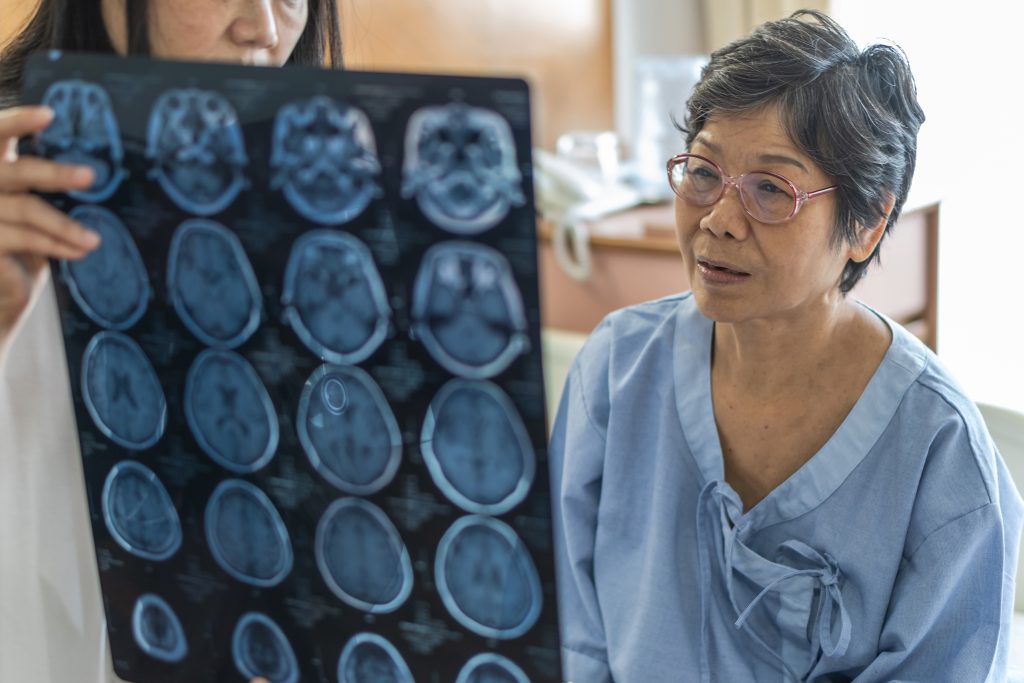
My 75-year-old mother slipped on the ice this winter and hit her head. The doctor determined that she had a concussion. Should we be worried about the long-term health of her brain?
The most common form of head injury is
a concussion, which is classified as a mild
traumatic brain injury.
People who suffer from traumatic
brain injury (TBI) later in life have
an increased risk of showing signs of
dementia over time, but it’s unlikely the
injury was the cause of the condition, says Charles Bernick, M.D., MPH, the
senior director of Cognitive Disorders
with the Cleveland Clinic’s Lou Ruvo
Center for Brain Health. “It’s probably
more the fact that these injuries affect
cells in the brain, so it reduces your
reserve. If a process is starting, let’s say
Alzheimer’s disease, you may show the
symptoms sooner because you’ve had an
additional insult to the brain. Whatever
the cause, a head injury later in life could
have clinical consequences, but I don’t
think there’s convincing evidence that one
head injury, particularly a concussion,
itself leads to Alzheimer’s disease.
“Alzheimer’s begins in the brain
10 years before you have symptoms.
What’s happening is if a person is
starting the process and then gets a TBI
it reveals the symptoms. They become
more apparent because it’s docked your
reserve or your ability to compensate,
so the injury will contribute to it getting
worse. It’s not necessarily the injury that
caused it.”
Bernick notes that one sign is a head
injury that fails to improve over time, as
it normally would.
“If it’s progressively getting worse,
then there’s probably something there
beforehand that’s being unmasked by
the injury.”
My grandson started playing football at 7. Should I be concerned about head injuries?
Children under 13 or 14 should only play flag football because “there’s a lot of changes happening in the brain,” Bernick says. After that, “I think we can say that the risk of developing long-term brain damage from playing sports, even football, is probably pretty low if you don’t make it past the high school level.”
“If you’re playing Division 1 football in Alabama and you’re a linebacker, that may be a different story. At least through high school, there’s probably very little risk of long-term brain injury.”
It is true that repetitive head impacts can cause a specific disorder termed Chronic Traumatic Encephalopathy (CTE), a disease marked by progressive worsening in mental functioning. CTE can only be verified by autopsy. However, there are a variety of symptoms that suggest the possibility of CTE.
“It’s usually difficulty with short-term memory,” Bernick says. “Along with what we call executive function, like problem-solving, judgment, and reasoning. You can have behavioral problems; people may become more explosive and aggressive. Mood disorders are common, like depression, hopelessness, anxiety. Some people actually do have physical symptoms that look like Parkinson’s disease. They can have slurred speech. They can have impaired coordination.”
Bernick said one study found that 90 percent or more of former NFL players who donated their brains showed pathological signs of CTE. “This is likely an overestimate of how common CTE is in former professional football players. For example, individuals or families that request a brain autopsy are more likely to be the ones that are symptomatic and thus have greater concern.”

What are some important
things people should know
about concussions?
“A concussion is a short-lived
neurological symptom that results from
an impact to the head. It can range
from being briefly ‘stunned’ to losing
consciousness, with or without other
symptoms such as dizziness, headache,
visual disturbance or incoordination,”
Bernick says.
“The symptoms are due to the
mechanical stretching of nerve fibers that
cross throughout the brain. A blow to
the head causes the brain, which has the
consistency of Jell-O, to move or twist as
it sits in the skull, resulting in shearing
of the fibers. Most symptoms will resolve
within a short period of time. Indications
to seek urgent medical assessment would
be loss of consciousness or ongoing
drowsiness, worsening headache, any
loss of strength, sensation, coordination
or slurred speech, mental confusion,
recurrent vomiting or seizures.”
Are there any harmful myths
about concussions?
One myth is that loss of consciousness
is required to have a concussion. In
fact, most concussions do not result in
complete loss of consciousness, Bernick
says.
“Another myth is that the best
treatment for concussion is to avoid
any activity or stimulation in the days
following. Though it is best to not try
and rush back to usual activities, it can
be helpful to slowly add more activity
as tolerated. Your doctor can help you
determine the right pace for returning to
your normal schedule,” he says.

Charles Bernick, M.D., MPH, has been guiding the Cleveland Clinic’s Professional Athletes Brain Health Study for more than 15 years. Adapted from an AFA Care Connection webinar. Go to alzfdn.org/webinar_archive to view this and others.